
Guardsman Air Duct Cleaning in Union City: A Homeowner’s Guide
Guardsman air duct cleaning in Union City isn’t a separate cleaning method. It’s a brand of antimicrobial treatment products applied after mechanical duct cleaning, and it only makes sense under specific contamination conditions. If your ducts are simply dusty, Guardsman treatment adds cost without adding benefit. If you’ve had moisture, mold-like growth, or persistent odor problems, that’s where the conversation changes.
What Guardsman Products Actually Do at the Duct Surface Level
The word “treatment” gets thrown around a lot in the duct cleaning industry, and it’s time someone explained what it actually means. Guardsman is a line of EPA-registered antimicrobial formulations manufactured by Abatement Technologies, the same Atlanta-based company that builds commercial-grade air filtration and source-removal equipment. Their products are designed for application to non-porous interior surfaces after source removal cleaning.
Here’s the key distinction most Union City homeowners never hear: Guardsman products are not cleaners.
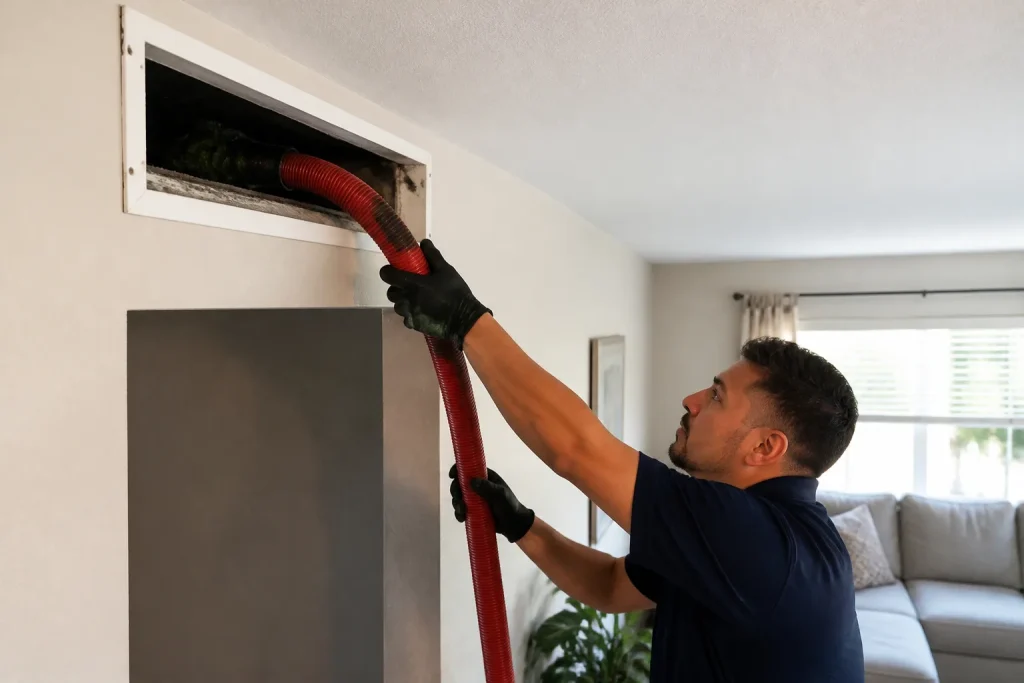
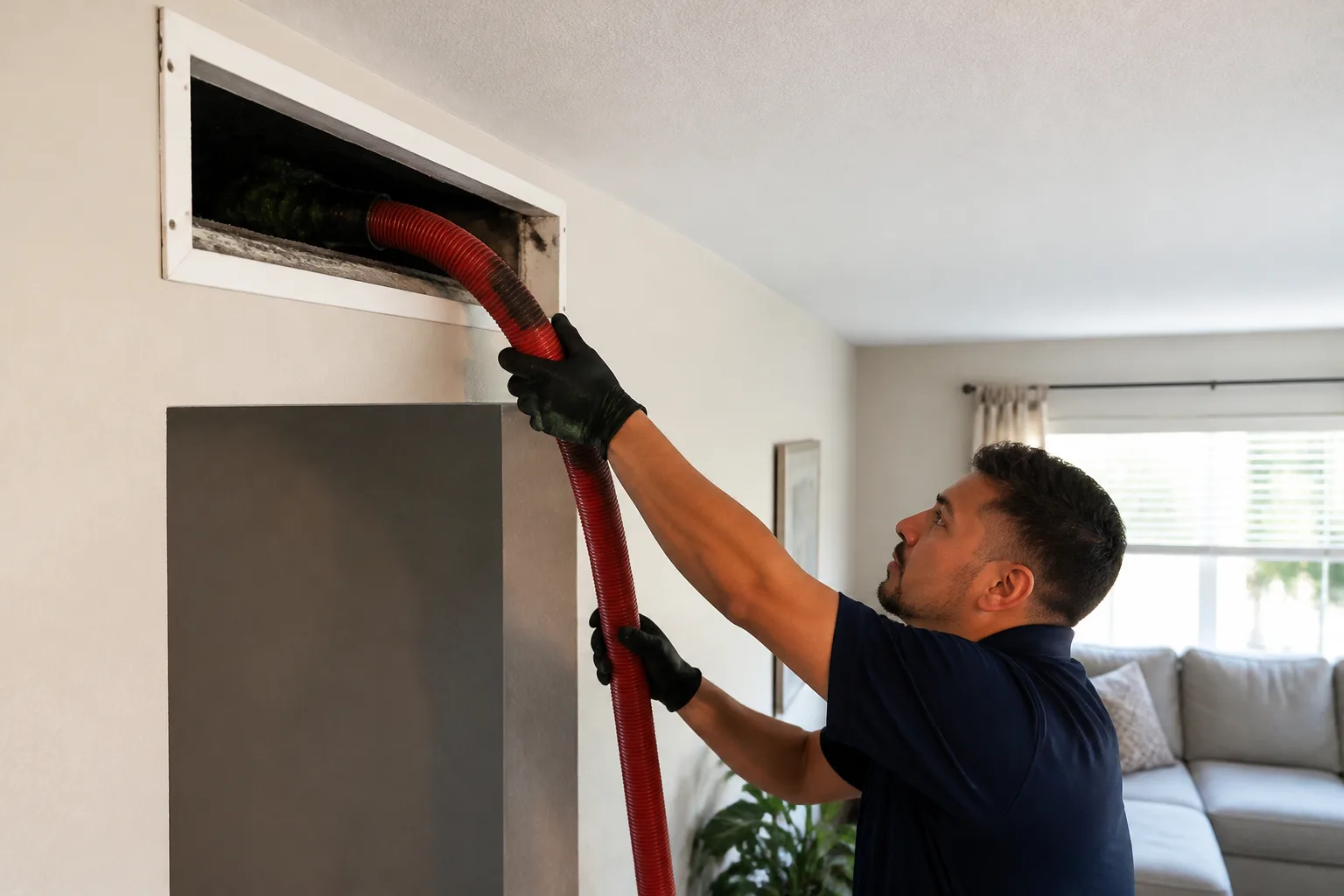
They are surface treatments. Let us explain what that means mechanically. During a proper duct cleaning, our Rotobrush or Nikro system uses agitation and negative air pressure to physically dislodge and extract debris from duct walls. That’s the cleaning step. After that step, the interior surfaces of your ducts are physically clean but microbiologically active in some cases. Mold spores, bacteria, and odor-causing microbes can remain attached to surfaces at a microscopic level. Guardsman formulations are sprayed as a fine mist onto those cleaned surfaces, where they kill existing microbes and leave a residual barrier that inhibits regrowth.
That residual action is what separates legitimate antimicrobial treatment from the pseudo-treatments some contractors offer. A deodorant spray masks smell. A sanitizer reduces microbial load for a limited window. Guardsman’s EPA-registered products are tested and labeled for specific dwell times and dilution ratios, and those are matters of record, not marketing.
When Guardsman Treatment Makes Clinical Sense in Union City
Let’s be straight with you: antimicrobial treatment is not a default add-on for every duct cleaning job in Union City. We’ve walked away from jobs where a customer asked for it and the conditions didn’t warrant it. Applying it unnecessarily isn’t just wasted money. It’s the wrong tool for the job.
Here are the specific scenarios where Guardsman treatment is genuinely justified:
- Documented moisture intrusion or past condensation problems. Union City’s marine-influenced climate produces significant indoor humidity from roughly May through October. Older homes without mechanical dehumidification often show condensation inside metal supply plenums and at register boots. If moisture has been present long enough, microbial growth becomes a legitimate concern.
- Visible mold-like growth during inspection or cleaning. If a camera inspection before cleaning reveals the characteristic staining pattern, mechanical cleaning removes the surface growth but doesn’t address spores embedded in duct wall irregularities.
- Persistent musty or sour odors that survive source removal. Some odor sources are compositional, not debris-related. When physical cleaning doesn’t eliminate the smell, it tells us the problem is microbial at the surface level.
- Post-remediation verification. After a flood, a leak, or a bathroom exhaust failure that pumped moisture into the duct system, homeowners often want a documented sanitation step before reoccupying the conditioned space.
What about households with allergy-sensitive occupants? Here the answer is more nuanced. HEPA-level source removal cleaning removes the particulate load that triggers most allergic responses. Guardsman treatment is not an allergy solution by itself. If a Union City homeowner’s primary concern is dust, pet dander, or pollen, the mechanical cleaning is the workhorse. The antimicrobial step addresses a different problem: living organisms, not inert particles.
The Application Sequence: Why Cleaning Must Come First
In our experience, this is where many Union City homeowners have been sold something that wasn’t what it appeared to be. The sequence matters, and it matters more than the product brand.
Here’s how legitimate Guardsman application works, in order:
- Inspection. A camera is run through the duct system to identify debris load, contamination type, and any damage. In Union City’s older housing stock, this step frequently uncovers disconnected branch runs and crushed flex sections.
- Source removal cleaning. The Rotobrush or Nikro agitation system is run through the entire system while negative air pressure contains and extracts loosened debris. This is the main event. It’s the step where 95% of the visible problem is resolved.
- Optional repair. If the inspection or cleaning reveals damaged duct sections, this is the point where our Air Duct Repair in Union City service becomes relevant. Damaged flex runs, detached takeoffs, and open plenum joints need structural correction before any treatment is applied.
- Guardsman application. Only after the system is clean and structurally sound is the antimicrobial product applied at its labeled dilution ratio, using a specialized fogger or sprayer, with the prescribed dwell time observed before the system is returned to service.
Why does order matter? Because antimicrobial products work on contact. They don’t penetrate debris. A quarter-inch of accumulated dust between the product and the duct surface means the product never reaches the surface it’s supposed to treat. Applying Guardsman to dirty ducts is like painting a wall before washing it. The paint covers the surface, but you’ve simply sealed in the problem and masked it temporarily.
This is also why we’re skeptical of any Union City duct cleaning quote that bundles “sanitizing” into a remarkably low base price. Proper application requires labor, time, and product volume. If the math doesn’t work, someone’s cutting a corner.
Encapsulants, Sanitizers, and Deodorizers: Understanding the Product Line
The Guardsman line is not one product. It’s a family of formulations addressing different contamination categories, and understanding the difference is useful when you’re comparing quotes or reviewing what a previous contractor claimed to apply.
Here’s the breakdown, plain English:
- Antimicrobial sanitizers. These are designed to reduce the population of bacteria, fungi, and viruses on treated surfaces to a level the EPA considers safe. They’re the workhorse for general post-cleaning sanitation and for odor control caused by microbial activity. If you’ve had one musty-room problem, this is typically the formulation in play.
- Antimicrobial encapsulants. These are heavier-duty. Encapsulants are intended for use on surfaces where microbial contamination is more established or where complete mechanical removal isn’t possible due to surface porosity. They form a coating that seals residual contamination and prevents spore release. Union City homes with original fiberglass duct board from 1970s and 1980s construction are common candidates here because duct board is porous and can’t be cleaned to bare metal.
- Deodorizers. These address odor only. They neutralize smell-causing molecules but do nothing to the microbial source. If someone offers “sanitization” but the product label says deodorizer, they’re selling you air freshener at antimicrobial pricing.
How do you verify what you’re getting? Ask the contractor to show you the product label before application, not after. The label will state what the product is registered to do. Ask for the EPA registration number. Ask what dilution ratio will be used. Ask what the required dwell time is, and ask how that dwell time will be observed before your HVAC system is turned back on. A legitimate operator answers these questions directly because the answers exist on the label. A less-than-legitimate operator changes the subject.
Older Union City Homes and Antimicrobial Treatment: What Changes
Pre-1990 construction in Union City presents a meaningful variable in antimicrobial effectiveness. Many of these homes were built with original metal rigid duct and fiberglass-lined sections. The fiberglass lining was standard practice in the 1970s and 1980s because it offered built-in thermal insulation and some sound attenuation. It also offers something else: a fibrous surface that holds both mechanical debris and microbial contamination far more tenaciously than smooth metal.
When we run a Rotobrush agitator through a fiberglass-lined plenum, it removes loose debris and a significant portion of surface contamination. But the structure of the fiberglass material itself means we can’t achieve the same “clean to bare metal” outcome you’d get on a smooth galvanized branch run. This is precisely where Guardsman encapsulant becomes relevant. When the substrate can’t be made perfectly clean through mechanical means alone, encapsulation provides a legitimate fallback: seal the residual contamination rather than attempt to scrub porous material indefinitely.
Newer Union City construction, generally post-2005, is a different picture. These homes typically use R-6 or R-8 flex duct throughout. Flex duct has a smooth interior liner. Mechanical cleaning is highly effective on this material. If the contamination is surface-level microbial, sanitizer application after cleaning gets excellent results. The discussion of encapsulant usually doesn’t arise for these homes because the surface isn’t porous enough to justify the heavier product.
One more variable unique to Union City: the town sits at the eastern edge of the San Francisco Bay’s marine layer influence. During summer, many Union City evenings bring fog and cool moist air that can persist until mid-morning. Older HVAC systems with oversized cooling capacity can produce interior condensation cycles inside supply plenums. When that happens repeatedly over years, it creates conditions where microbial populations become established on the interior surfaces. Homeowners who’ve noticed discoloration around ceiling registers in upper-floor rooms should take it seriously. This isn’t cosmetic. It’s evidence the duct environment has been consistently wet at times, and wet duct surfaces are what antimicrobial treatments were designed to address.
The Bottom Line
Guardsman is a legitimate brand from an established manufacturer, and its products have defined, verified applications in residential duct systems. What matters in Union City is whether the application matches the problem. Clean, dry ducts don’t need antimicrobial treatment. Contaminated or moisture-compromised ducts might. And no treatment, Guardsman or otherwise, replaces thorough source removal cleaning performed with professional equipment. Cleaning always comes first.
If you’re in Union City and wondering whether your ducts need cleaning, treatment, or repair, Duct Cleaning Union City offers free estimates. We’ll inspect the system, show you what we find, and tell you honestly what’s necessary and what isn’t. Call (877) 824-3121 to schedule. More detail on our process is available at our Air Duct Cleaning in Union City page, or visit our Duct Cleaning Union City home page for a complete overview. Dryer vent work is available as a separate service, covered on the Dryer Vent Cleaning in Union City page.
Frequently Asked Questions
Is Guardsman the same thing as duct cleaning?
No. Guardsman products are antimicrobial treatments applied after mechanical duct cleaning. They are not a cleaning method and cannot substitute for source removal. Any company positioning “Guardsman cleaning” is blurring the distinction, either deliberately or out of confusion. The correct sequence is always: mechanical cleaning with professional agitation equipment first, then surface treatment if the contamination scenario justifies it.
How do I know the product was actually applied?
Ask to see the product label before application and request documentation of the EPA registration number, dilution ratio, and dwell time. A legitimate technician will show you the product in its original container. Be wary if the label isn’t shown, if the container arrives unmarked, or if the “sanitizer” smells strongly like air freshener. Deodorizers are not sanitizers, regardless of how the service is described on an invoice.
Does antimicrobial treatment eliminate the need for duct cleaning?
No, and this is a claim that should trigger immediate skepticism. Antimicrobial products work on clean surfaces. They cannot penetrate accumulated dust, debris, or biofilm. If a contractor offers “sanitization” as a shortcut around mechanical cleaning, they’re selling the wrong service for the wrong reason. Mechanical cleaning with Rotobrush or Nikro equipment is the foundation. Treatment is an optional post-cleaning step.
How often should Guardsman treatment be reapplied?
There is no standard reapplication schedule, and a contractor who tries to sell you an annual antimicrobial subscription is being creative with the facts. For most homeowners, one post-cleaning application after a legitimate contamination event is sufficient. The residual protection degrades over time depending on system conditions. If your ducts stay dry and clean, there’s no reason to reapply. If underlying moisture or contamination returns, that’s a structural or source problem that should be corrected, not repeatedly treated.
Written by the team at Duct Cleaning Union City, serving Union City since 2015.
Need Air Duct Cleaning Help?
Call Duct Cleaning Union City - licensed & insured, with free written estimates in Union City.
(877) 824-3121